



A study updating the list of potential breast carcinogens
The Food Packaging Forum compared the updated database on migratory and extractable chemicals in contact with food (FCCmigex) with the list of potential breast carcinogens compiled by the Silent Spring Institute, finding 41 new chemicals to be included in the list, 6 of which are confirmed carcinogens.
- New substances identified: The number of potential breast carcinogens detected in packaging rose from 189 to 230 in the latest update (2025).
- Migration to food: 113 of these substances have been shown to “migrate” (move from packaging to food) under normal conditions of use.
- Biological confirmation: Six confirmed carcinogens (with direct evidence in rodent models) have been detected migrating from materials such as PET plastic, polyamide, and paper in markets in the EU and China.
Materials with the highest risk
More than 75% of food contact chemicals (FCCs) relevant to breast cancer were detected in items made of plastic. However, all material groups except glass* contained some of these chemicals.
- Plastics: This is the material in which the most carcinogenic substances have been detected, with 77% of the substances identified.
- Paper and cardboard: In second place, with 89 substances identified.
- Metals and glass*: Glass is the safest material, but the plastic coatings on cans and the seals on metal lids are critical points of contamination.
Substances critical to health
Ten chemicals are most frequently detected in food contact packaging and are linked to breast cancer.
- Di(2-ethylhexyl) phthalate
- Dibutyl phthalate
- Bisphenol A
- Diisobutyl phthalate
- Benzophenone
- Diethyl phthalate
- Butyl and benzyl phthalate
- Styrene
- Dimethyl phthalate
- Irganox 1010
In this new update from the Food Packaging Forum, six additional FCCs have been detected that have been shown to cause breast cancer.

The Food Packaging Forum foundation has detected the presence of six additional FCCs with proven capacity to cause breast cancer.
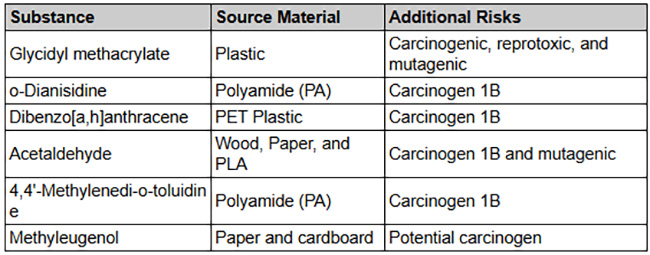
In this new update from the Food Packaging Forum, six additional FCCs have been detected that have been shown to cause breast cancer.
Study conclusions
Various studies conducted by the Food Packaging Forum foundation show that chronic exposure to these substances is the norm worldwide.
These chemicals were detected in products purchased around the world:
- Americas: Mexico, Brazil, Canada, and the US.
- Europe: Spain, Germany, Austria, Denmark, among others.
- Asia and Africa: China, India, Egypt, Nigeria, and Turkey.
The study identified 230 potential breast carcinogens present in food contact materials. Of these, 113 have been shown to migrate into food under normal conditions of use. The detection of six confirmed carcinogens in products purchased in European Union markets is particularly alarming.
Although the EU, US, China, and Canada have laws prohibiting genotoxic carcinogens, these substances are still present on the market, as indicated by various studies conducted by the Food Packaging Forum.
This shows that regulation is not enough and that these carcinogenic substances are not being kept out of the food chain.
Experts conclude that reducing chemical exposure through packaging is an opportunity for mass breast cancer prevention that is currently underestimated by public health authorities.